 RemoteShift
How to Make Money on YouTube as a Beginner
YouTube can become a real income stream — but it's not fast money, and it's not only about ad revenue. A beginner can earn through affiliate links, services, digital products, sponsorships, and eventually YouTube's own ad monetization. The strongest channels don't wait for ads. They use useful videos to build trust, then connect that trust to relevant offers from the very first upload.
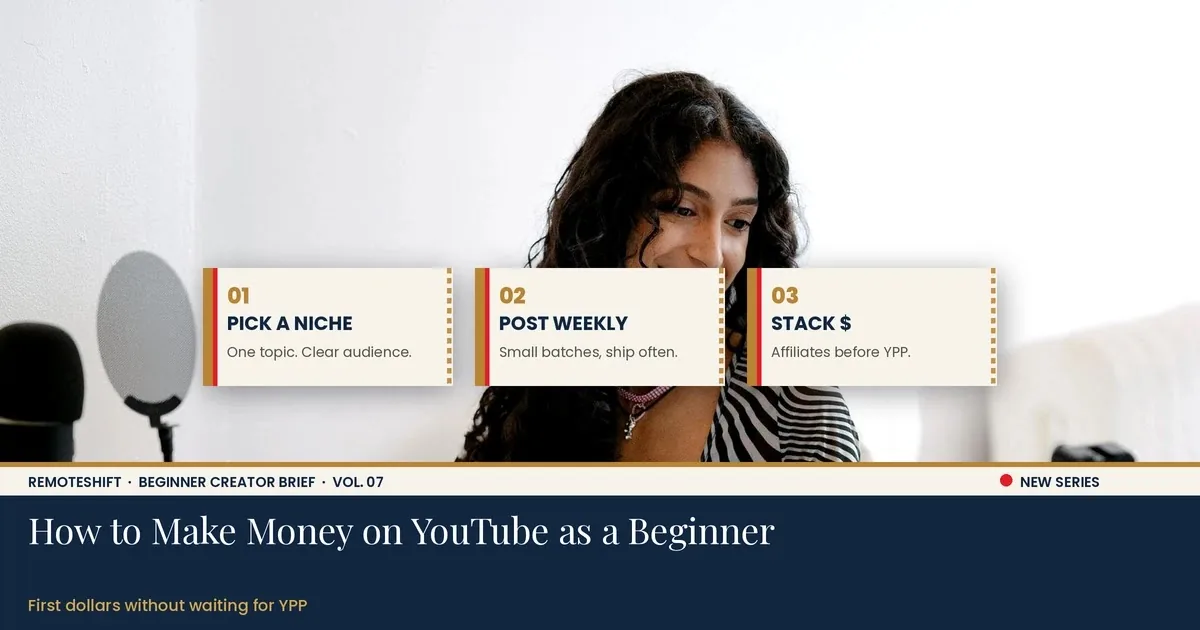
This guide covers whether YouTube is actually right for you, how the income streams work, what the monetization milestones are, which channel model to choose, and exactly what to do in the next 30 days. No inflated income claims, no course waiting at the end.
Reality check first: YouTube is a long-term audience asset. It is not the best path if you need guaranteed income within the next 30 days. Build it alongside a faster income path — a service, remote job, or reselling — rather than treating it as an emergency paycheck.
Is YouTube a good income path for you?
YouTube may be a good fit if you can explain, demonstrate, review, compare, or simplify useful topics; stay focused on one audience problem for several months; publish consistently even before you see results; and build trust before expecting income. You don't need expensive equipment, professional editing skills, or a large audience to start. You need a clear topic, a repeatable format, and patience to improve.
It may be a poor fit if you need immediate guaranteed income, dislike creating any form of content, or want a completely passive business from day one. Knowing this upfront is more valuable than a year of grinding the wrong path.
How YouTube creators actually make money
Most beginners think YouTube income means ads. Ads matter, but they're only one piece — and usually the last one to arrive. Here's the full picture:
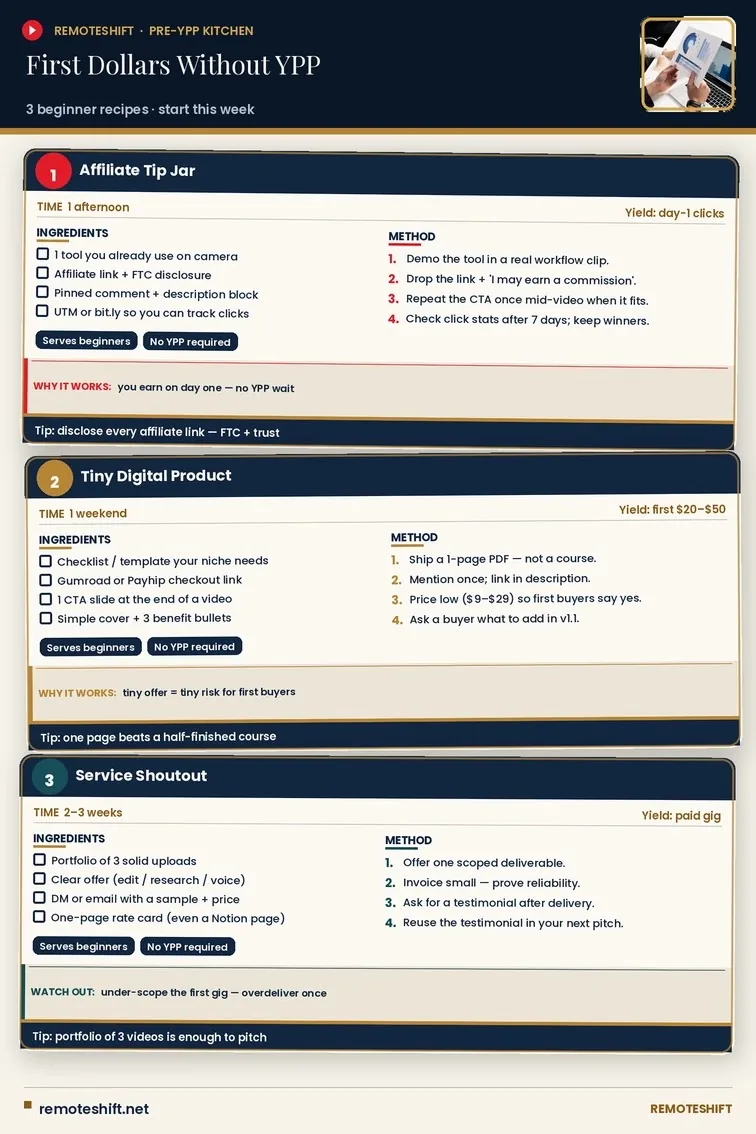
Affiliate links — recommend tools and products relevant to your niche in your video description. Can start before your first subscriber. A channel about remote-work tools can earn affiliate commissions from productivity apps, equipment, or platforms it recommends. Services — use the channel to attract clients for consulting, freelancing, coaching, or AI services. Works early, even on a small channel. Digital products — templates, checklists, guides, mini courses. Once you have an audience that trusts you, these pay far more per follower than ads do. Sponsorships — brands pay for mentions in your videos, but this typically requires real reach (tens of thousands of engaged viewers). Build toward it, don't wait on it. YouTube ad revenue — comes after hitting the YouTube Partner Program threshold (more on that below). Memberships and fan funding — for loyal communities. Usually comes later when viewers genuinely want to support you.
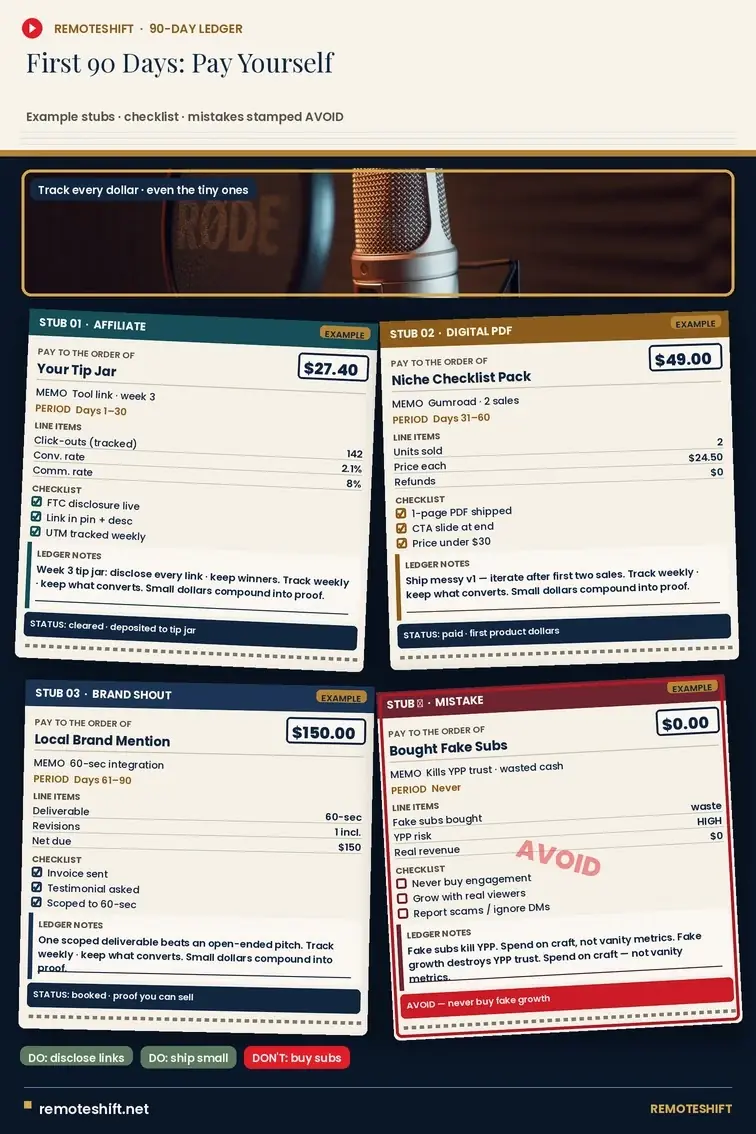
The practical lesson: don't wait for ads before thinking about income. Start with affiliate links the moment you have a relevant audience, even a small one.
YouTube Partner Program: the two monetization milestones
YouTube has two important earning stages in eligible countries.
Earlier YPP access (some fan-funding and Shopping features): 500 subscribers, 3 valid public uploads in the past 90 days, and either 3,000 valid public watch hours in the past 12 months or 3 million valid Shorts views in the past 90 days.
Full ad revenue access: 1,000 subscribers, and either 4,000 valid public watch hours in the past 12 months or 10 million valid Shorts views in the past 90 days.
Reaching the numbers doesn't guarantee approval — your channel must also follow YouTube's monetization policies, use original content, and meet payment requirements. Check your current eligibility inside YouTube Studio → Earn, and review YouTube's official Partner Program page for the current rules, since thresholds can change.
Change coming on February 1, 2027: YouTube says new applicants to the full YouTube Partner Program will need 1,000 subscribers plus either 8,000 qualified watch hours in the last 365 days or 20 million qualified Shorts views in the last 90 days. Channels already in the program are not affected, and the earlier-access tier (500 subscribers plus 3,000 watch hours or 3 million Shorts views) stays the same. Check YouTube's official notice before you plan around these numbers.
Choose your channel model before you start
On-camera works when your personality, experience, or direct explanation is the main value. You're the face and voice; viewers connect with you specifically. Faceless works when the tutorial, screen recording, or visual explanation carries the lesson — no camera or even your voice required. This model has low startup cost and high AI leverage; see the full guide on how to start a faceless YouTube channel for the detailed breakdown. AI-assisted uses AI for research, outlines, captions, and editing support, but you still review and shape every output. YouTube automation means you delegate repeatable tasks to freelancers — but only after you've proven that one original video format works. Don't start with full automation. Outsourcing a weak idea produces more weak videos.
Choose on-camera or faceless as your primary format. Decide this now, before you open a channel settings page.
Pick a niche that can become a real business
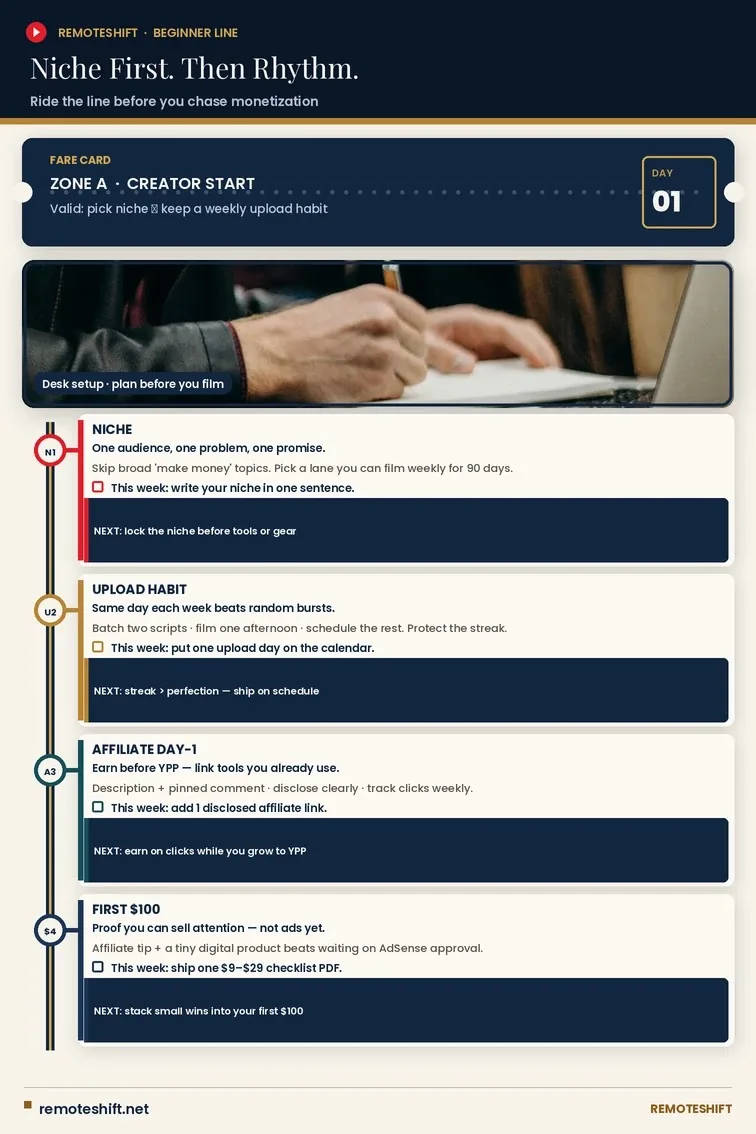
A niche isn't just a topic — it's the specific audience problem you choose to solve. Use this formula: Audience + Problem + Helpful Outcome. Examples: remote job seekers + poor interview setup + clearer online interviews; beginner freelancers + no client system + simple organization workflows; new computer users + confusing software + beginner-friendly tutorials.
Avoid broad niches like "motivation," "business," or "technology." Make one clear promise instead: "I help beginner remote workers understand which online income paths actually fit their situation." A clear promise helps viewers understand why to subscribe — and makes affiliate links, services, and digital products easier to connect naturally to every video.
Before committing, ask five questions: can I create at least 30 useful video ideas around this? Are people already searching for help with this topic? Can I explain, demonstrate, or solve problems in this area? Is there an honest income model beyond ads? Can I stay interested for at least 90 days? If the answer to all five is yes, you have your niche.
Build a channel of videos that have a job
Not every video needs to sell something, but every video should have a purpose. Search videos answer questions people already ask — they bring in viewers over time through organic search. Trust videos show your thinking, experience, and perspective — they build the relationship that converts viewers into buyers. Conversion videos connect a useful problem to a relevant next step — they must still be genuinely helpful even if nobody buys anything, or they damage trust instead of building it.
A healthy YouTube channel mixes all three. Early on, lean toward search videos to build visibility. As your audience grows, lean into trust and conversion content.
Your first 30 days: a realistic plan
Days 1–7: Choose one audience and one clear problem; pick your production model (on-camera, faceless, or AI-assisted); create a simple channel name and one-sentence promise; list 30 video ideas; start your channel setup.
Days 8–14: Choose one specific beginner question; create a simple five-point outline; record with your phone, screen recorder, or slides; focus on clarity, not perfection; publish your first video.
Days 15–21: Create two Shorts from the same topic to attract discovery. For example, if your long video is "How to Start Freelancing With No Portfolio," your Shorts could be "The fastest way to get your first client" and "The one thing most beginner freelancers skip."
Days 22–30: Review what happened. Which title got clicks? Which video held viewers longest? Which questions appeared in comments? Don't change your niche after one weak video. Test one clear format before deciding whether to improve, narrow, or pivot.
Not sure if YouTube is the right income path for your situation, or whether something else — remote work, services, flipping — fits you better right now? Our free 60-second quiz points you at the path that actually matches your skills, time, and how soon you need money. Take it at remoteshift.net.
FAQ
How long does it take to make money on YouTube as a beginner?
Affiliate income can start with even a small engaged audience — sometimes in months one to three for channels that choose the right products for their niche. Ad revenue from the YouTube Partner Program typically takes three to nine months of consistent weekly publishing to reach the qualification threshold. Meaningful monthly income usually develops between months six and eighteen.
Can you make money on YouTube without a lot of subscribers?
Yes. Affiliate links, services, and digital products don't require minimum subscriber counts — just a relevant audience that trusts you. Many creators earn their first income before hitting 1,000 subscribers because they attached an offer to their content from the start.
What type of YouTube channel makes the most money for beginners?
Channels in high-CPM niches like personal finance, business, technology, and health tend to earn more per thousand views from ads. But the income model matters as much as the niche — a channel that earns affiliate commissions and sells services can out-earn a channel that waits for ad revenue alone.
Do you need to show your face to make money on YouTube?
No. Faceless channels earn through the same streams as on-camera channels: ads, affiliate links, services, digital products, and sponsorships. YouTube monetization rules apply equally to both. Many top-earning channels in finance, history, and technology are entirely faceless.
What's the biggest mistake beginners make on YouTube?
Waiting for ad revenue before thinking about income. Most channels that successfully generate money connect affiliate links, a service offer, or a small digital product to their content from the very beginning — and don't wait until they have 1,000 subscribers to start earning.