 RemoteShift
How to Sell Digital Products (Without an Audience)
Digital products — templates, guides, spreadsheets, planners — are the closest thing to passive income a beginner can actually build. You create the file once and every sale after costs you nothing to deliver. The catch nobody advertises: the product is the easy part. Distribution is where most people fail. Without a marketplace that already has buyers searching, a digital product earns nothing. This guide covers what actually sells, where to sell it with zero audience, and the honest economics of building this as a business.
Digital products are the most misrepresented business model on the internet. The pitch says "make it once, earn while you sleep." The reality says "make it once, then learn that nobody buys things they can't find."
Both halves are true. So this guide covers both.
What digital products actually are
Digital products are files people pay to download — templates, planners, guides, spreadsheets, swipe files, checklists, short ebooks, mini-courses delivered as PDFs. You create the product once, and every sale after that costs you nothing to deliver. No inventory, no shipping, no client meetings, no supplier.
That's the structural advantage. You're not trading hours for money — you're trading the hours you spent creating it for every sale that comes after. The math looks great on a whiteboard. The problem is you have to get people to find it in the first place, and that's the part the pitch leaves out.
The people earning steadily from digital products aren't doing something magical. They're doing two things: making products that solve painfully specific problems, and putting those products where buyers are already looking. That's it. No magic, no shortcut — just specificity and placement.
The honest economics
Most digital products earn very little. Not because digital products don't work, but because most are made first and marketed never. Someone spends a month building something interesting, lists it, and waits. Waiting is not a distribution strategy.
The products that earn share two traits. They solve one specific, painful problem — not a vague category, a specific problem a specific person has right now. And they sit where buyers are already searching, not on a blank storefront the creator built and hoped people would find.
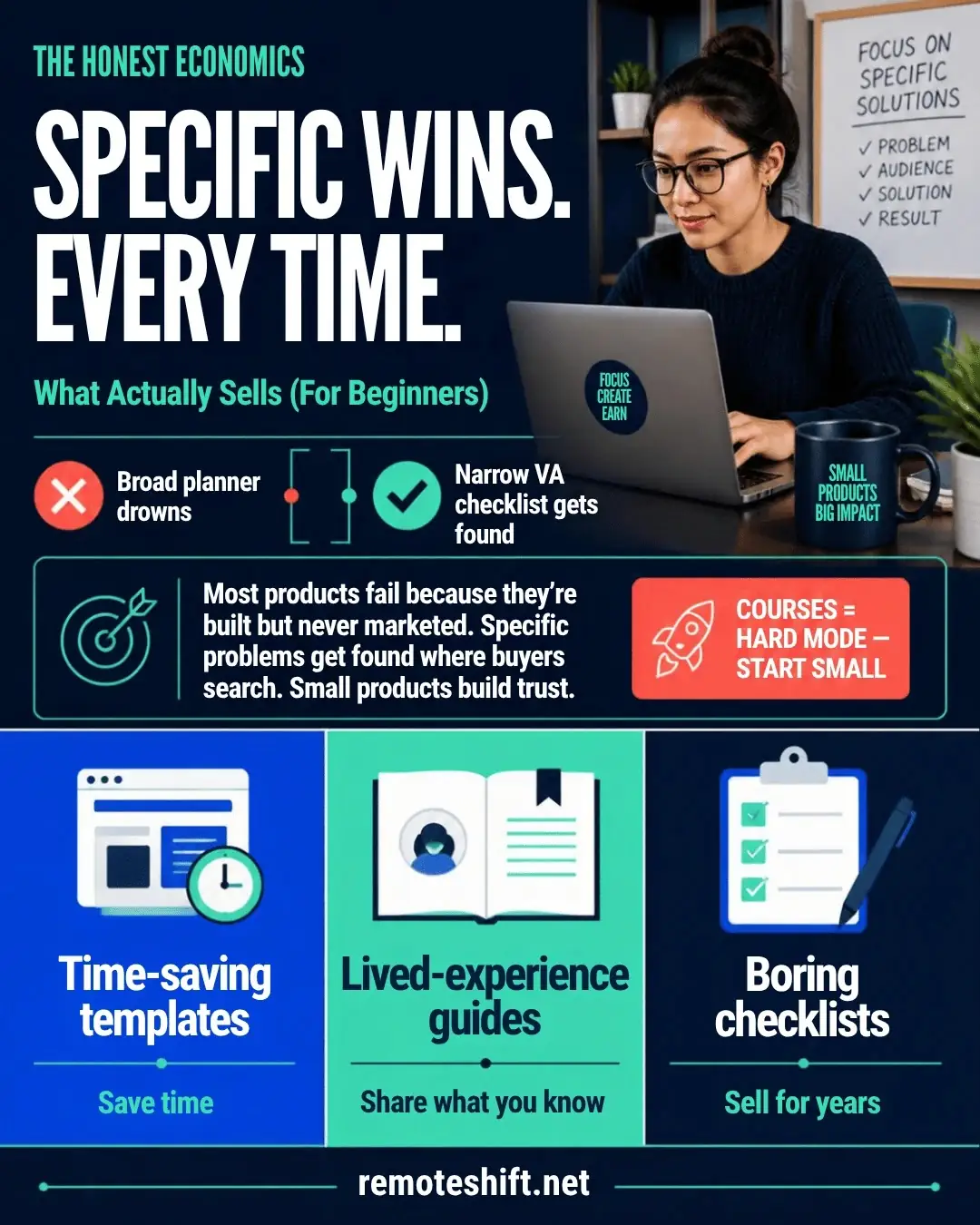
A generic "productivity planner" drowns among ten thousand identical planners. A "client onboarding checklist for freelance virtual assistants" gets found by exactly the person who needs it, because nobody else bothered to make it. Specific wins. Every time. The mistake is making the broad thing because it feels more valuable. It isn't. The narrow version earns more, gets found easier, and takes less time to make.
Small, specific products sell comfortably between $5 and $29. Don't agonize over price — pick a number and treat it as a test. A price is not a tattoo. Watch what happens and adjust.
What actually sells for beginners
Templates that save working people time. Email templates for customer support replies. Spreadsheets for tracking freelance invoices. Canva social media templates for small business owners. People pay to skip an hour of setup — that's the easiest "yes" in this entire model. You've probably made tools like this for yourself without realizing they'd sell.
Guides built from real experience. If you've done something others are trying to do — passed a remote job interview, set up a home office on a tight budget, landed remote clients from outside the US — a focused, honest PDF guide built from that experience beats a generic ebook ten times out of ten. Your lived experience is the moat. Nobody else has it, and buyers can feel the difference between someone who's done it and someone who's rewritten Google results.
Checklists and systems. The unsexy champions. A step-by-step system for a boring but necessary process sells steadily for years, precisely because nobody glamorous wants to make it. The boring things are the reliable things.
Notice what's not on this list: courses. Courses are digital products on hard mode — long to build, expensive to host, and nearly impossible to sell without an existing audience that trusts you. Earn that trust first with something small and affordable. Use what you learn to build what's bigger.
How to create your first product this week, not this quarter
Start with a problem you've already solved. Not a problem you read about — one you've actually lived through. That's where the credibility in your product comes from, and it's the thing no one else can replicate. Your specific experience with a specific problem is the edge.
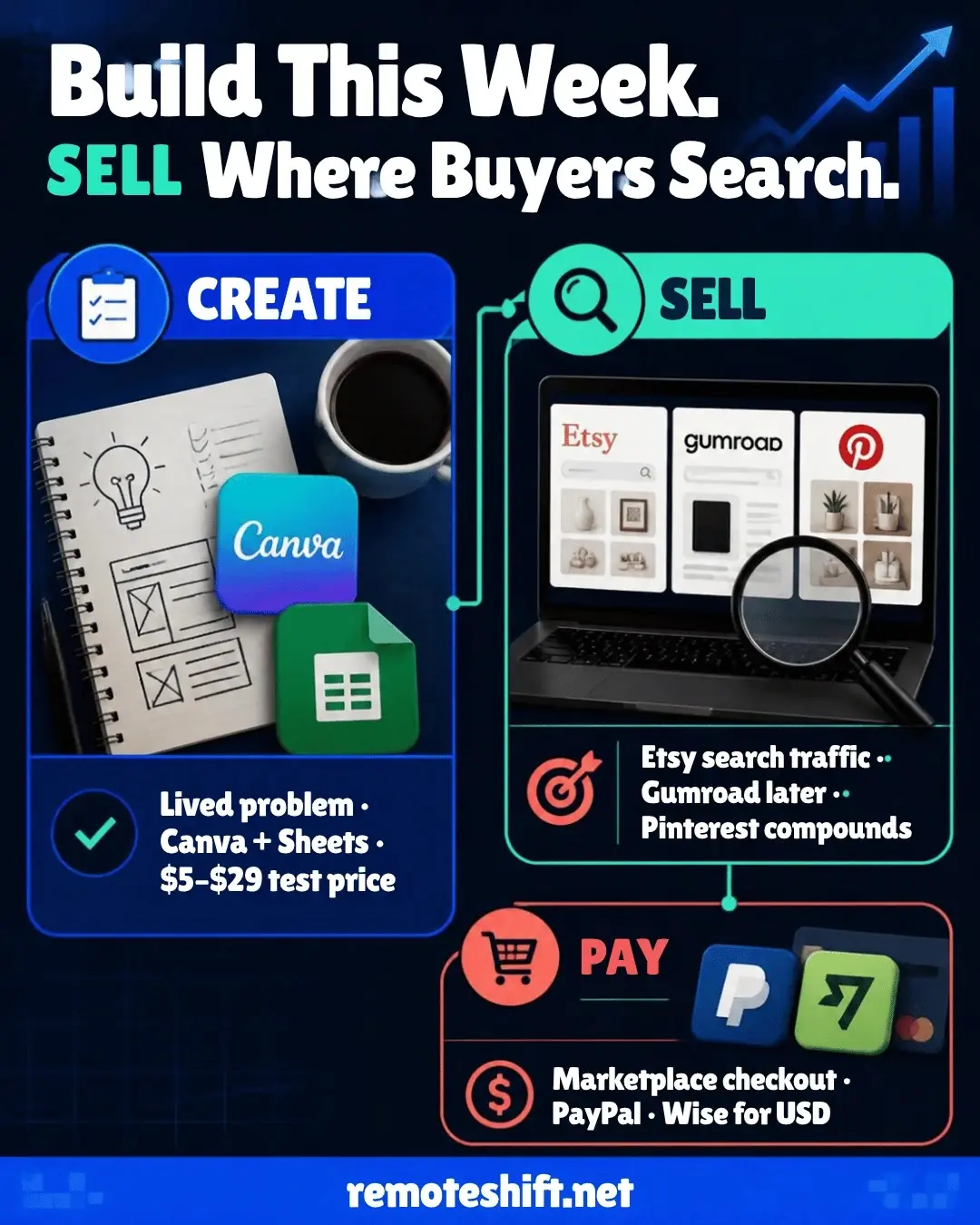
Build it with free tools. Canva creates templates and PDFs that look genuinely professional and requires no design skills. Google Sheets makes trackers, systems, and calculators. Google Docs works for guides and checklists. Your first product should take a few days to make, not a few months. Speed matters more than polish here, because the market's reaction is the only feedback worth having — and you can't get that feedback until you've shipped something.
Make the smallest sellable version first. List it. Learn from who buys it and what they say. Version two, funded by version one's sales, will always be better than version one perfected in isolation. Don't wait until it's perfect. It will never be perfect in your head. Ship, then improve.
Where to sell when you have zero audience
This is the question that decides everything, so here's the straight answer: piggyback on marketplaces that already have buyers searching for exactly what you're selling.
Etsy. The most powerful starting point for templates, planners, and guides. Most people don't realize Etsy sells digital downloads — but its search engine actively brings buyers to you. You pay a small listing fee, Etsy takes a small cut per sale, and in exchange you get access to millions of active buyers looking for exactly the kind of files you're making. For a beginner with no following, Etsy is the most direct path to a first sale.
Pinterest. The unfair advantage for digital product sellers, and completely faceless. Pinterest is a search engine where people actively look for planners, templates, and guides before they buy. A Pinterest account with consistent, simple pins pointing to your Etsy shop can drive genuine sales with no camera, no follower count anywhere, and no following to speak of. It's slow at the start and compounds steadily over months — exactly the kind of trade that rewards patience.
Gumroad and direct storefronts. Simpler to set up than Etsy, but bring zero built-in traffic. These work well once you've got even a small audience — a modest Pinterest following, a tiny email list, a handful of people who already trust you. Not the right starting point when you're starting from zero.
Getting paid is the simple part. Marketplaces handle checkout automatically. For direct sales from outside the US, a Wise account lets you receive USD payouts without losing a significant cut to poor conversion rates. Most platforms also support PayPal, which covers a wide range of buyers worldwide. Disclosure: the Wise link is an affiliate link — RemoteShift earns a small commission at no cost to you.
The mistakes most beginners make
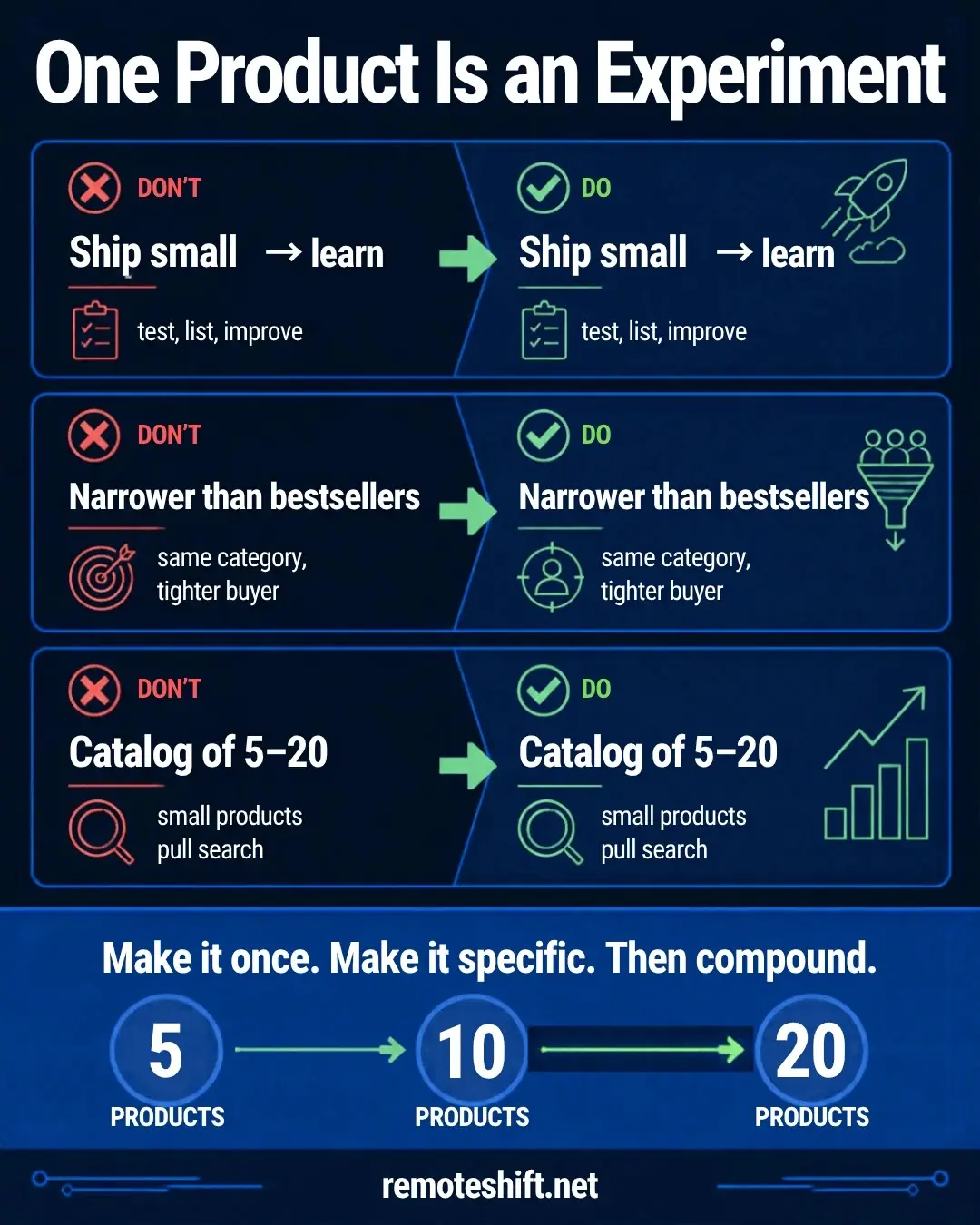
They build for weeks before testing for a day. The minimum viable product exists for a reason — make something sellable, put it in front of buyers, get feedback, then improve. Don't spend a month polishing something the market hasn't asked for yet.
They copy bestsellers exactly. If a planner is the top seller in a category, they make an identical planner. The bestseller already owns that search result. Your edge is the narrower version — same category, more specific buyer, less competition, easier to rank for.
They treat one product as the business. One product is an experiment. The actual business is the catalog — five, ten, fifteen small products, each solving a specific problem, each pulling its own search traffic from slightly different buyers. That's when "make it once" starts compounding into something real. If the first product teaches you something, the second one is already better before you build it.
How digital products connect to everything else
Digital products pair naturally with other online income paths. The systems you build delivering a productized service — your checklists, templates, client-facing documents, workflows — are sellable products hiding in plain sight. You're being paid by clients to create your future digital product catalog at the same time. If you're also using AI to speed up delivery, as in an AI services business, the same leverage applies: tools and systems you build become sellable assets.
Not sure whether digital products are the right starting point for you compared to the other paths — remote work, affiliate marketing, services, YouTube, newsletter, AI services? Our free 60-second quiz looks at your background, time, and constraints and matches you to the path that actually fits. Take it at remoteshift.net.
FAQ
Can you sell digital products with no audience?
Yes — but only if you sell on marketplaces where buyers are already searching. Etsy is the strongest starting point for templates, planners, and guides because its search engine brings buyers to your listings. Pinterest is the other effective channel: it works without a following and compounds over time. A standalone storefront with no traffic source is not a strategy.
What digital products sell best for beginners?
Templates that save time (email templates, spreadsheet trackers, Canva designs), focused guides built from real experience, and checklists or systems for specific processes. Small, specific, and practical beats broad and impressive every time. Courses are the hardest starting point — build trust with smaller products first.
How much can you earn from digital products?
The range is enormous. Most beginners earn nothing because they skip distribution. Sellers with specific products on Etsy plus consistent Pinterest traffic can build to $300–2,000/month over 6–12 months. A catalog of 10–20 products compounds faster than a single product ever can.
What tools do I need to create digital products?
Canva (free tier) for templates, PDFs, and planners. Google Sheets for trackers and spreadsheets. Google Docs for guides and checklists. You need nothing paid to make your first product. Design quality matters less than specificity and usefulness.
How do I get paid for digital products from outside the US?
Etsy pays via Payoneer or direct deposit in supported countries. For direct sales, PayPal works for a wide range of buyers, and Wise gives you US account details that accept USD without the poor conversion rates of standard bank wire. Check your specific country's Etsy payout options before you start.
Pay and price figures in this guide are typical ranges from public listings and platform pages, not guarantees. Your rate depends on your skills, country, client and platform.