 RemoteShift
Remote Customer Service Jobs: The 5 Fastest Paths
Remote customer service jobs typically pay $12–$22 an hour for support roles, $15–$28 for technical support, and $18–$35 for customer success — all in USD, and many companies hire globally. If you've worked in a call center, BPO, or any customer-facing role, you have a head start because the core skills transfer directly.
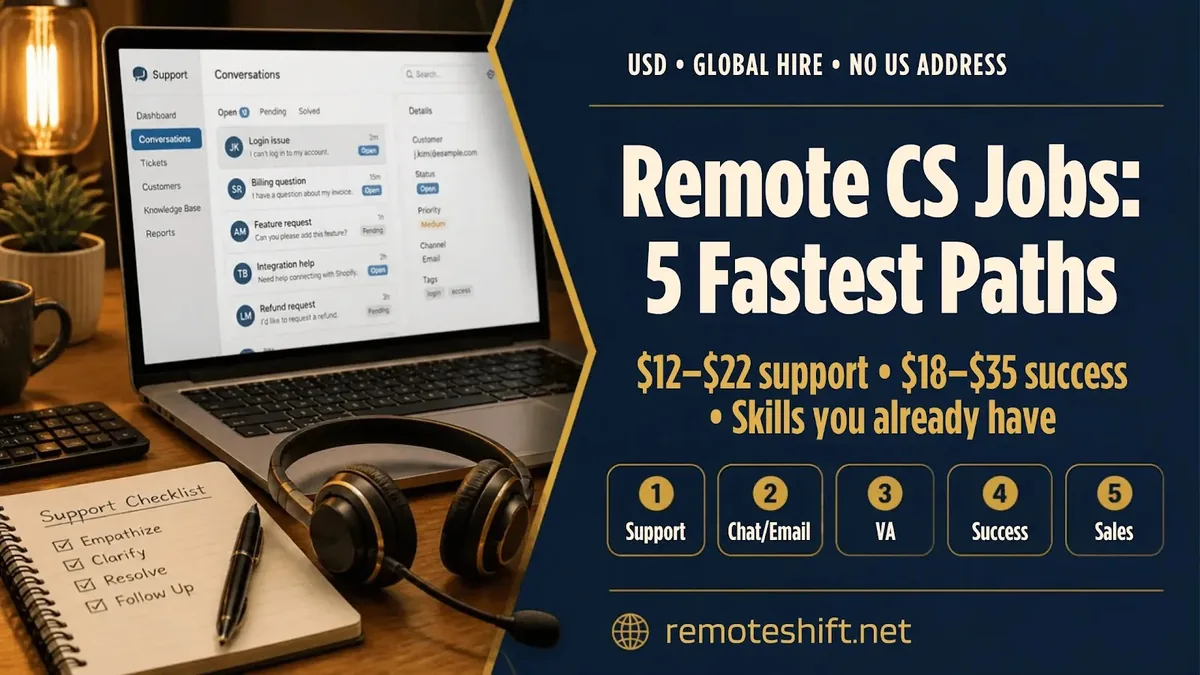
Here's what most people in this situation don't realize: the door isn't closed. It isn't even locked. Companies in the US, UK, and Australia are posting remote customer service jobs every week and looking for people who can actually do the work under pressure without supervision.
You've been doing exactly that for years. The question isn't whether you're qualified — it's which role fits you best, and how fast you can get there.
1. Remote customer support (the fastest path in)
This is the most direct transfer there is. Companies running software, e-commerce, and SaaS products need someone who can resolve issues, stay calm when a customer is frustrated, and write a clear reply without a manager standing over their shoulder. That's your Tuesday. That's your normal.
Remote customer support roles typically handle tickets, live chat, and email — sometimes phone, but many companies have moved away from it entirely. Pay runs $12–$22 an hour in USD. Entry-level roles are available regularly because growing companies always need more support capacity.
If you're coming from a call center or BPO background, this is the shortest distance between where you are and a remote paycheck. The same skills you use today — active listening, problem-solving, clear communication — are exactly what the job description asks for.
2. Chat and email support (no phone required)
A quieter version of the role above, and worth calling out separately. A growing number of companies run customer support entirely through chat and email with no voice calls at all. If phone work burned you out, if your written English is stronger than your spoken English, or if you just want the flexibility of async work, this is the lane.
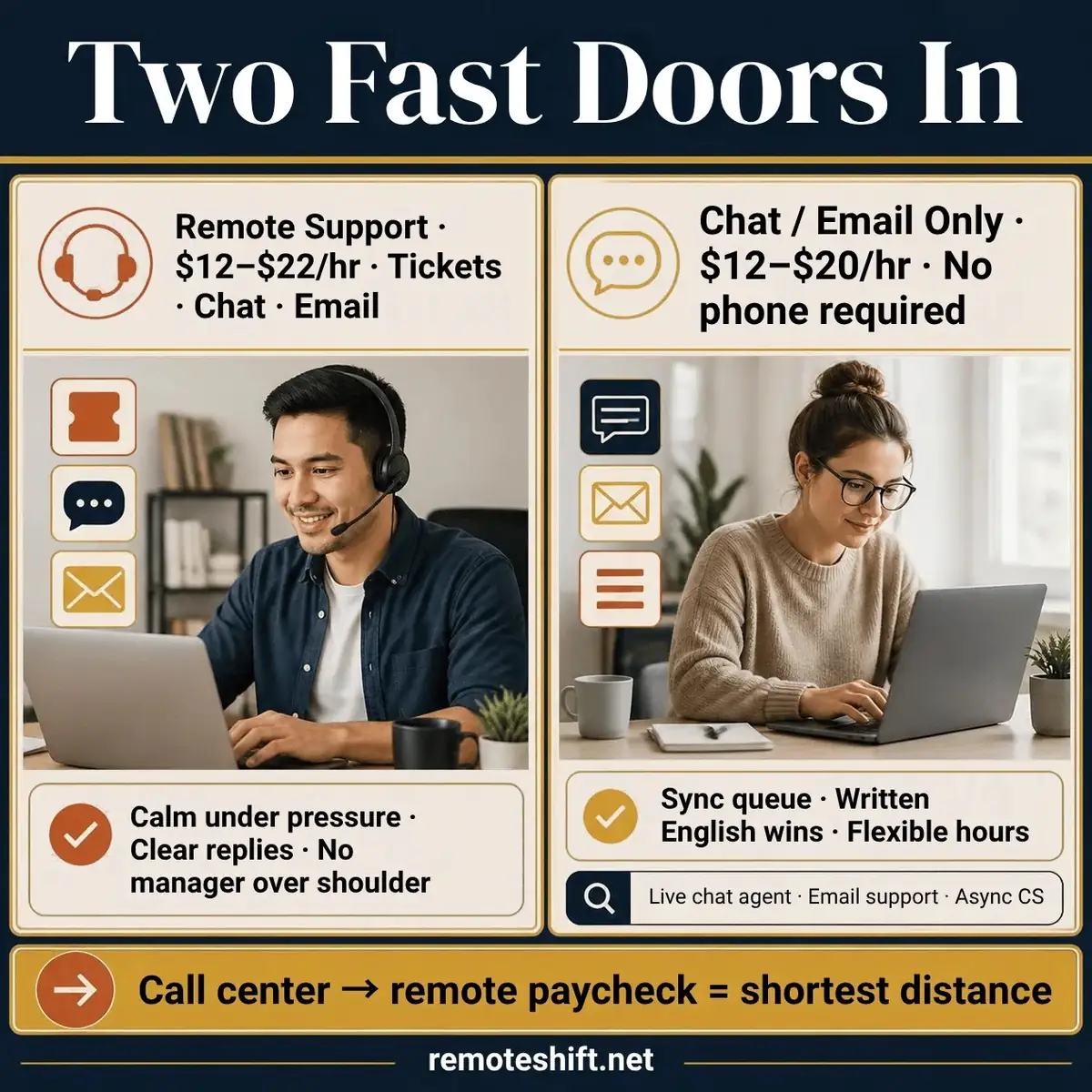
Pay is similar to phone-based support — $12–$20 an hour — and the work is often more flexible on scheduling. You handle customer questions in writing, work through a queue, and move at your own pace within the deadline. For a lot of people, this is actually the better version of the job they've been doing.
Search specifically for "remote live chat agent," "email support specialist," or "async customer support" to find these roles.
3. Virtual assistant (the broadest path)
VA work blends customer service with admin — managing inboxes, handling client communication, scheduling, light research, and the dozen other small tasks that eat a business owner's day. Your background in customer-facing work is directly relevant because so much of VA work is exactly that: communication, keeping things organized, and making sure nothing falls through the cracks.
Entry-level VA roles start at $8–$15 an hour. With a few months of experience and good reviews, $20–$35 is realistic. Demand is steady — every founder and small business owner who's growing needs reliable support they can't yet afford to hire in-office.
If you want the full breakdown on how to position yourself for VA work with no prior remote experience, here's the complete guide to becoming a virtual assistant.
4. Customer success (support's better-paid sibling)
Customer success is different from support in one key way: instead of fixing problems after they happen, you help customers get real value from a product so they stay. That means proactive outreach, onboarding, relationship-building, and catching issues before they become reasons to cancel.

It leans on everything you're already good at — reading people, explaining things clearly, handling frustration before it escalates, keeping relationships intact under pressure. Companies pay a premium for this because retaining a customer costs far less than acquiring a new one.
Pay typically runs $18–$35 an hour, with full-time salaries from $45,000–$70,000 a year at US companies. It takes slightly more positioning to land your first customer success role — you'll need to frame your CS experience in terms of customer outcomes, not just tickets resolved — but your existing track record is the raw material.
5. Remote sales and appointment setting
If you've got any sales experience — even light upselling or retention calls — this can pay the most and hire fast. Results are easy to measure and companies always want more revenue, which makes them quick to hire when the right candidate shows up.
Appointment setting is a friendly entry point: you reach out to warm leads, have initial conversations, and book interested people onto calls for a closer to handle. You're not doing the full close — you're starting conversations and not taking "not right now" personally. Which, again, you've been doing for years.
Pay varies from $12 an hour base to $30+ with commission, and top performers can earn considerably more.
A note on the pay figures: the hourly ranges in this post are estimates, not guaranteed rates. What you earn depends on the company, the client and where you live, and rates for workers outside the US are often lower. For a US reference point, the US Bureau of Labor Statistics reports a median of $19.08 an hour for customer service representatives (May 2023 data, all US employers).
Where to find legitimate remote customer service jobs
The platforms that actually list real remote CS roles — not aggregators padded with scam postings:

Upwork and Fiverr work for freelance-style roles where you build a profile, get reviews, and grow a client base. Good starting point if you want control over your schedule and don't want to wait for a company to hire you.
FlexJobs charges a small subscription fee but pre-screens every listing. Worth it specifically for customer service roles because this category attracts a lot of scam postings on free boards.
Remotive and Remote Rocketship — two more remote-only job boards worth checking daily: Remotive and Remote Rocketship. Free to browse, and the same scam test applies to every listing.
Remote.co lists vetted remote roles for free across industries, including customer support and virtual assistant work.
LinkedIn is underused for this. Search "remote customer service," "remote customer support," or "virtual customer success," filter location to Worldwide, and set an alert for daily new postings. A complete profile with specific metrics ("resolved 80+ issues daily, 95% satisfaction") performs significantly better than a generic one.
Indeed with a "remote" filter and last-7-days sort catches new listings before they fill up.
For a broader list of trustworthy boards and the scam red flags to watch for, see where legit remote jobs are posted (and how to spot scams).
Not sure which of these five paths fits your specific background? The free 60-second quiz at remoteshift.net matches your experience to the remote role most likely to get you hired first — not a generic answer, one based on what you've actually done.
How to position your CS experience for remote roles
The biggest mistake is sending an unchanged call center resume to a remote employer. Remote companies read resumes differently — they're checking whether you can work without supervision, whether you've delivered measurable results, and whether you communicate clearly in writing.
Swap vague descriptions for specific numbers. "Handled customer calls" becomes "resolved 80+ customer issues daily, maintaining a 97% satisfaction rating over 18 months." "Worked in a team" becomes "coordinated with billing and technical teams across time zones to resolve complex escalations." Use your real numbers, not these examples.
That specificity tells a remote employer everything. It shows accountability, clarity, and that you understand what remote work actually requires.
For a complete breakdown of how to make this transition — including the resume approach that works and the common mistakes that kill applications — here's the full guide on landing remote call center and customer support jobs.
Take the free 60-second quiz at remoteshift.net to find your best remote path and a clear starting point — not another list of things to try.
Disclosure: some links in this post are affiliate links. If you sign up through them, RemoteShift may earn a commission at no extra cost to you.
Frequently asked questions
What are remote customer service jobs?
Remote customer service jobs are support, success, and communication roles that are done entirely from home. They include customer support (tickets, chat, email, phone), virtual assistant work, customer success management, and appointment setting. Many hire globally and pay in USD through platforms like Upwork, Payoneer, or direct company payroll.
How much do remote customer service jobs pay?
Remote customer support roles typically pay $12–$22 an hour. Technical support pays $15–$28. Virtual assistant work starts at $8–$15 and rises to $20–$35 with experience. Customer success roles pay $18–$35 an hour or $45,000–$70,000 a year for full-time positions. All rates are in USD and vary by company; treat them as typical ranges, not guarantees.
Can I get a remote customer service job with no remote experience?
Yes. Remote employers hiring customer service roles care most about your communication skills, problem-solving ability, and reliability under pressure — not whether your previous job had "remote" in the title. Call center, BPO, and in-person CS backgrounds transfer directly. Focus on framing your existing experience with specific metrics.
Where can I find remote customer service jobs?
Upwork and Fiverr for freelance roles, FlexJobs and Remote.co for vetted full-time and part-time listings, and LinkedIn with a Worldwide location filter. Use a last-7-days sort on Indeed to catch fresh listings. Avoid job boards that don't verify postings — scam listings are common in this category.
Do remote customer service jobs require a degree?
Most remote customer service and support roles do not require a degree. They require reliable internet, clear communication, and proven experience handling customer issues. A strong Upwork profile with reviews or a resume showing measurable results can stand in for formal credentials.
Can I do remote customer service work if I live outside the US?
Often, yes. Remote customer service is one of the more location-flexible job categories, though some employers restrict hiring by country or time zone, so check each listing. USD pay received through Upwork, Payoneer, or Wise can be converted to your local currency.