 RemoteShift
Starting Remote Work in Your 40s or 50s? You're Not Behind
You are not too old to start a remote career in your 40s or 50s. Remote employers in customer support, coordination, and admin roles hire for reliability, calm under pressure, and the ability to work without supervision — qualities that come with life experience. Your real obstacles are smaller than they appear: the technology learning curve is gentler than you think, and the belief that it's "too late" is the biggest thing in your way.

You are not too old to start a remote career. Not at 45, not at 50, not at 55.
The world tries to make you feel like the door closed years ago — like remote work belongs to people half your age who grew up with a phone in their hand. That feeling is understandable. It's also wrong, and I want to tell you exactly why, plainly, because you've earned plain talk.
You're not behind. You're underestimated.
Start with what you're carrying that younger applicants simply don't have yet. You've spent decades learning how to deal with people. You can read a room, defuse a tense situation, and stay calm when everything's going sideways — because you've done it a hundred times in real life, not in theory. You know how to show up reliably, take responsibility, and finish what you start.
Employers say they want these things and they're not lying — mature, steady, dependable people are genuinely hard to find. The market doesn't undervalue your experience because it's worthless. It undervalues it because you haven't yet learned to point it at the right opportunities.
Remote work specifically rewards exactly what you have. Without an office environment and in-person supervision, companies are hiring on trust. They need to know you'll show up, hit your hours, deliver on your commitments, and communicate clearly without someone watching over your shoulder. That's a description of someone who's been professionally reliable for two or three decades — not someone two years out of school.
Where your experience actually pays
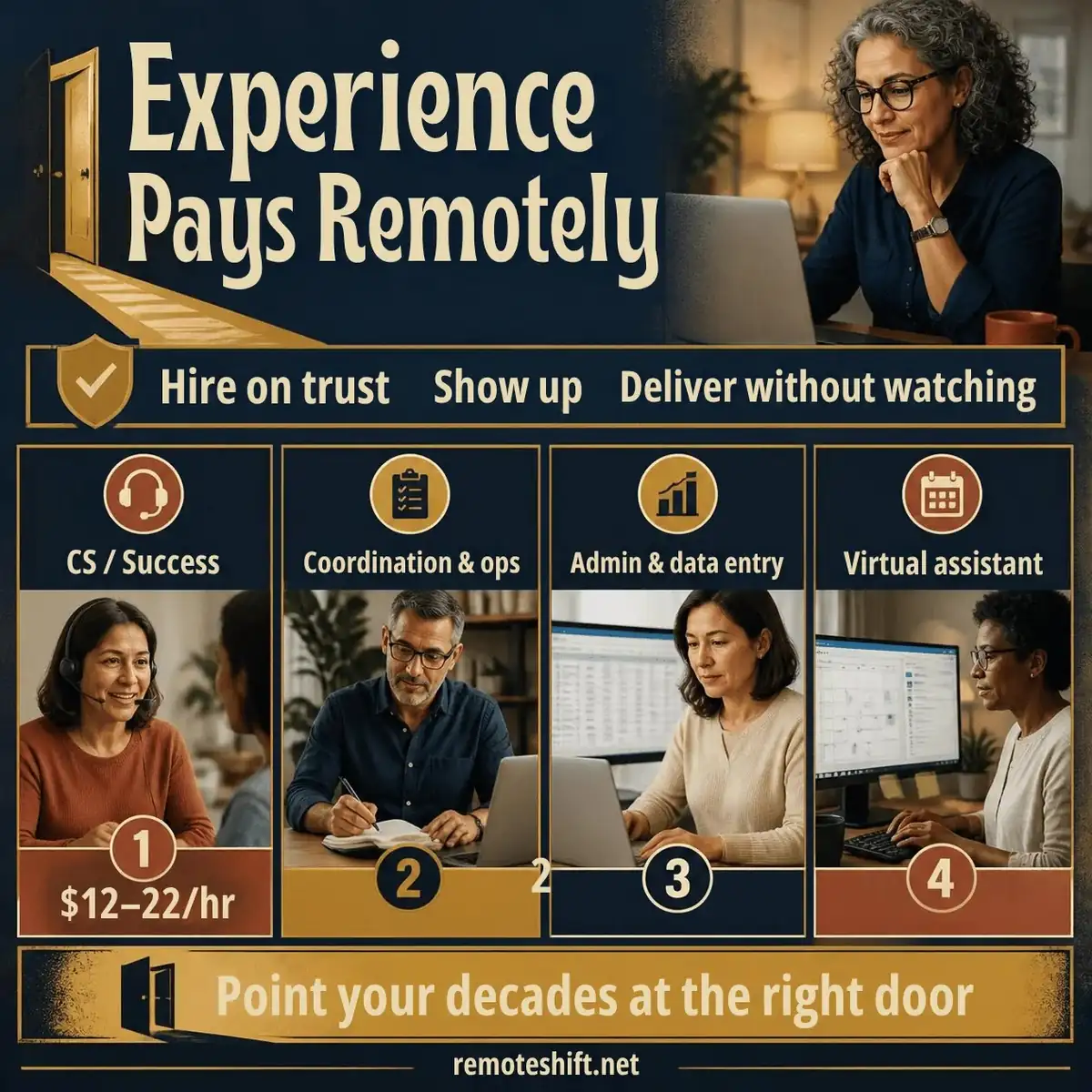
Remote customer support and customer success love people like you. When a customer is upset, a company doesn't want a panicked 23-year-old reading off a script. They want someone with the kind of steady calm that only comes from years of handling real human beings under pressure. That's you. Your decades of dealing with difficult situations aren't a liability — they're exactly the edge these roles reward, and they pay $12–22/hr USD to start with clear paths upward. If you're coming from a call center, see how call center agents land remote customer support jobs.
Coordination and operations roles suit anyone who's ever managed people, run a project, or been the person keeping multiple things on track. Younger workers are often still learning how to be the stable center when things wobble. You learned it the hard way, over years. That experience is worth real money to a company that needs someone they can trust to just handle things.
Admin, data entry, and back-office work doesn't care how old you are even slightly. It cares whether you're accurate, reliable, and consistent. Those qualities tend to strengthen with age, not weaken. It's not glamorous, but it's real work, it pays in USD, and it's the cleanest way to build a remote work track record if you're starting from scratch. Start with our guide to data entry jobs from home.
Virtual assistant work is another strong fit. Business owners and founders who need someone to manage their inbox, calendar, bookings, and basic coordination are often specifically looking for someone experienced and steady — not someone who needs hand-holding. The organizational skills you've built over decades of professional and personal life translate directly. Here's how to become a virtual assistant with no experience.
A note on the pay figures: the hourly ranges in this post are estimates, not guaranteed rates. What you earn depends on the company, the client and where you live, and rates for workers outside the US are often lower.
The two real obstacles — and why they're smaller than they look
Let me be honest about what's actually in your way, because pretending it doesn't exist would insult you.
Technology. A lot of people in this age bracket talk themselves out of remote work because they assume it requires technical skills they don't have. It mostly doesn't. If you can send an email, use a browser, and join a video call, you have most of what you need for a large range of remote jobs. Anything role-specific — a particular ticketing system, a project management tool, a CRM — you learn on the job the same as everyone else does. You don't need to become a tech expert. You need to stop letting "I'm not good with computers" be a bigger story than it actually is. Most of it is unfamiliarity, and unfamiliarity goes away with use.
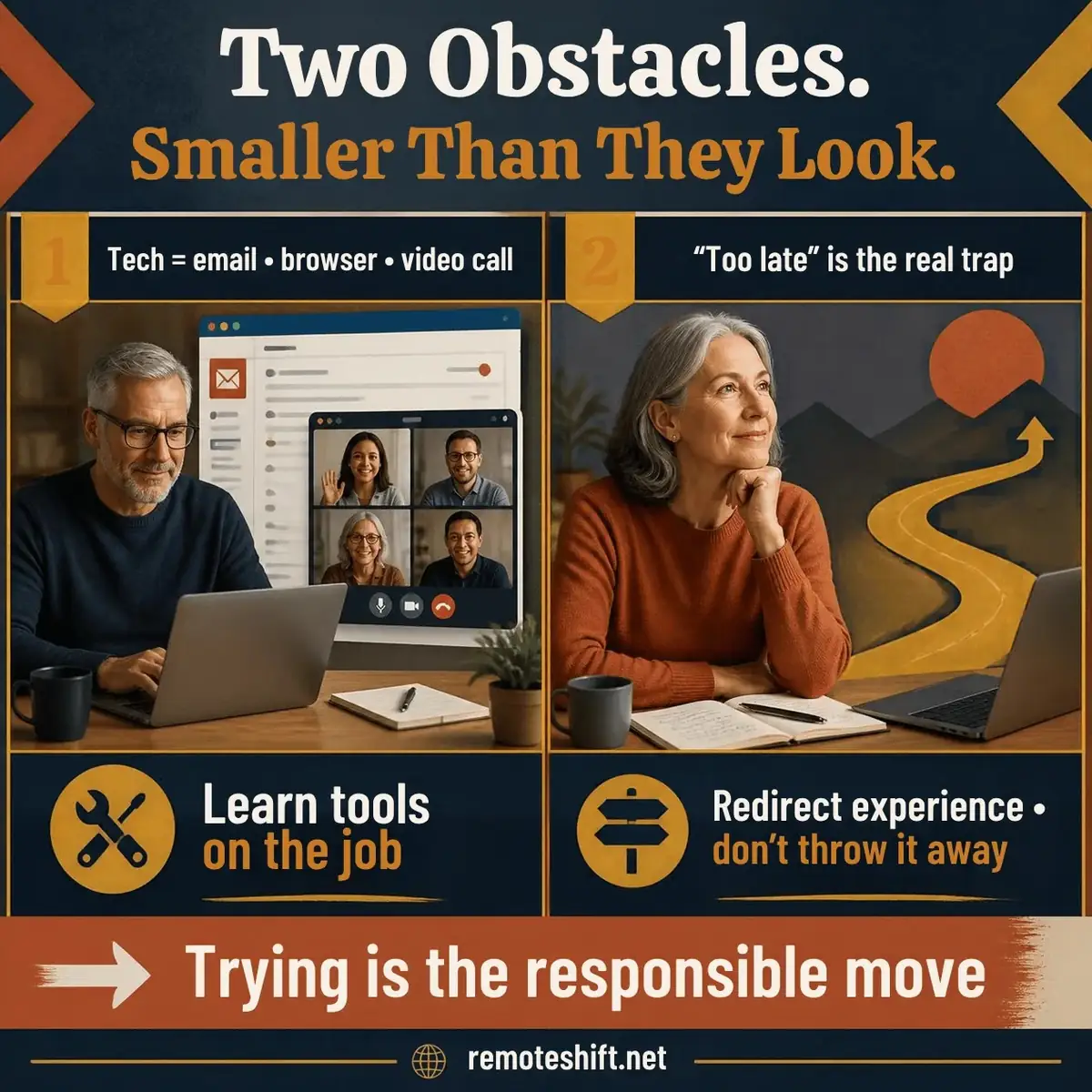
The belief that it's too late. This is the harder one. The feeling that everyone got a head start, that you're starting from zero, that the opportunity has passed. Let me push back on that directly. You're not starting from zero — you're starting from decades of experience that you're going to redirect, not throw away. And "too late" only makes sense if you'd rather do nothing and stay exactly where you are. If the alternative is a job that might not be there next year, trying something new in your 40s or 50s isn't a risk. It's the responsible move.
What honest progress looks like
It may take you a little longer to feel comfortable than someone who's been on screens since childhood. You might have to be patient with yourself while a few things feel unfamiliar. That's fine. Slightly slower to start is not the same as unable. The people who succeed at this aren't the youngest or the most tech-savvy — they're the ones who refused to count themselves out before they tried.
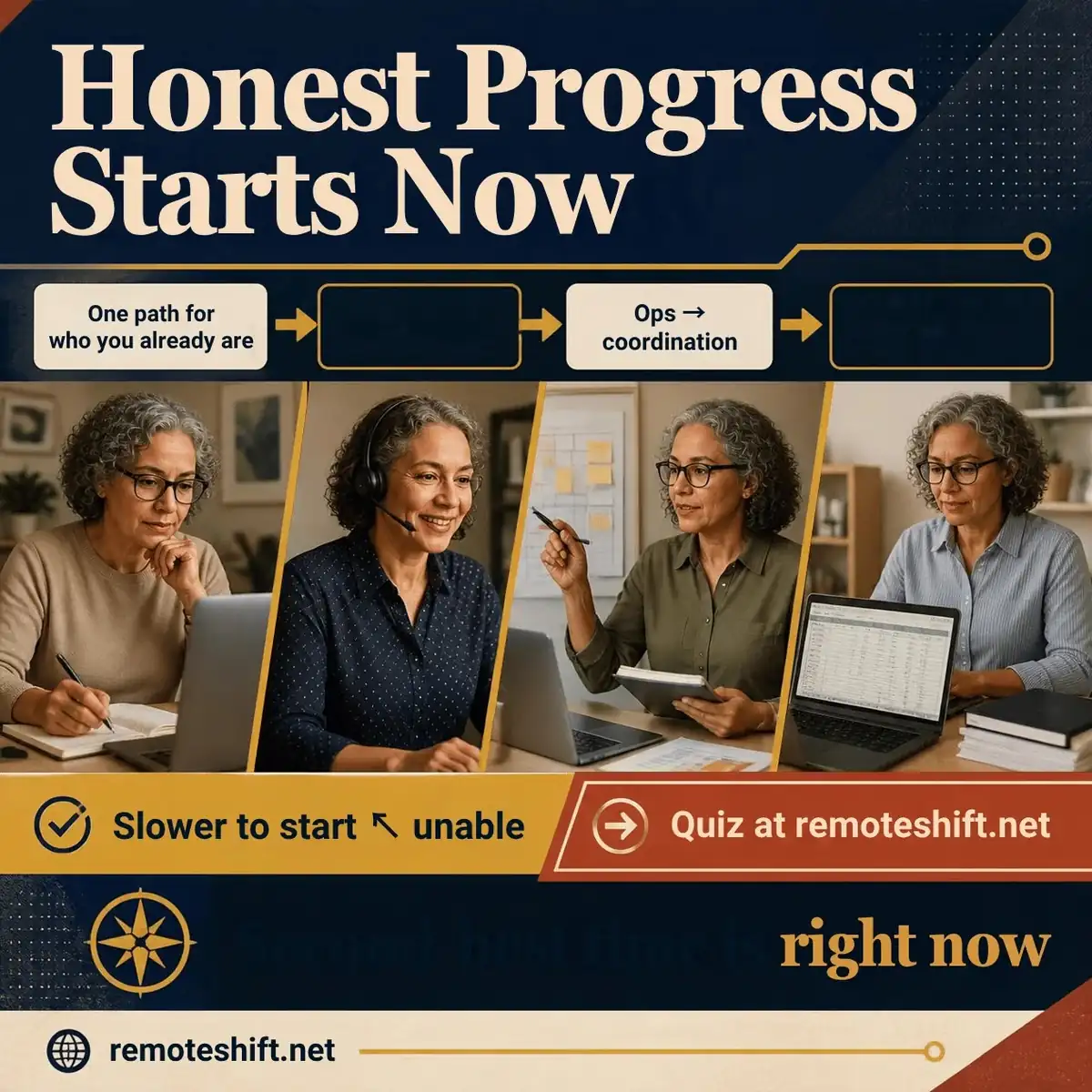
First step: don't try to figure out your entire next chapter in one evening. You need to identify the one right path for the person you already are — based on your actual experience, your strengths, and what you want your days to look like — and start there.
If you've spent years in customer service, that maps directly to remote support roles. If you've managed people or operations, coordination and EA roles are within reach. If you want something steady with lower pressure to start, admin and data entry are legitimate, real entry points — not dead ends.
Our free 60-second quiz takes your specific background and tells you which remote starting point fits you best. No assumptions about your age, no jargon. Take it at remoteshift.net.
When the first USD payment arrives, Wise is how most international remote workers receive it — real US bank details, mid-market exchange rate, fast deposits in your local currency.
The best time to start was years ago. The second-best time is right now.
Also worth reading
For the full job search process — where to apply, how to make your application work for remote employers, and what to expect — see our guide on how to get a remote job from outside the US. And if you've already started applying and hearing nothing back, our guide on why you're not getting remote jobs covers the five specific fixes that change results.
Disclosure: some links in this post are affiliate links. If you sign up through them, RemoteShift may earn a commission at no extra cost to you.
FAQ
Is 50 too old to start a remote career?
No. Remote employers are hiring for reliability, communication, and the ability to get work done independently — none of which diminishes with age. For customer-facing and administrative roles in particular, these are exactly the qualities that come with more work experience. Age is not the barrier it can be in some traditional in-office environments.
What remote jobs are good for people in their 40s and 50s?
Remote customer support, virtual assistant, operations coordinator, data entry, back-office admin, and customer success roles are all strong fits for people with professional experience. They value reliability, communication, and the ability to work independently — qualities that tend to be stronger in people with more work experience.
Do I need tech skills to get a remote job at 50?
Basic digital literacy is enough to start — the ability to use email, a browser, and video calling covers most of what entry-level remote roles require. Role-specific tools (ticketing systems, project management software, CRMs) are typically learned on the job. "Not being a tech person" is less of a barrier than most people in this age group believe it to be.
How do I explain a career change at 50 in a remote job application?
Be direct and confident. You're not starting from zero — you're redirecting decades of experience. Emphasize the transferable skills: communication, reliability, organizational ability, pressure management. Frame the change as applying your background in a new context, not abandoning one career for another. Remote employers hiring for support and admin roles respond well to this framing.
Can I work remotely if I'm not confident with computers?
For most remote support and admin roles, yes. The technology required is less advanced than most people assume — email, browser, video calls, and possibly one or two specific apps. If you can navigate these (and most people can with a bit of practice), the rest is learnable on the job. Don't let unfamiliarity with technology talk you out of a career change that your other skills genuinely qualify you for.