 RemoteShift
Why You're Not Getting Remote Jobs: 5 Fixes That Work
If you've applied for remote jobs and heard nothing back, the problem is almost never your skills or experience — it's almost always one of five specific, fixable mistakes in how you're applying. Treating a remote CV like a local one, not addressing independent work ability, mass-applying, no LinkedIn presence, and going after the wrong starting roles are the five reasons most people stay stuck. Fix any one of them and you'll notice a difference immediately.
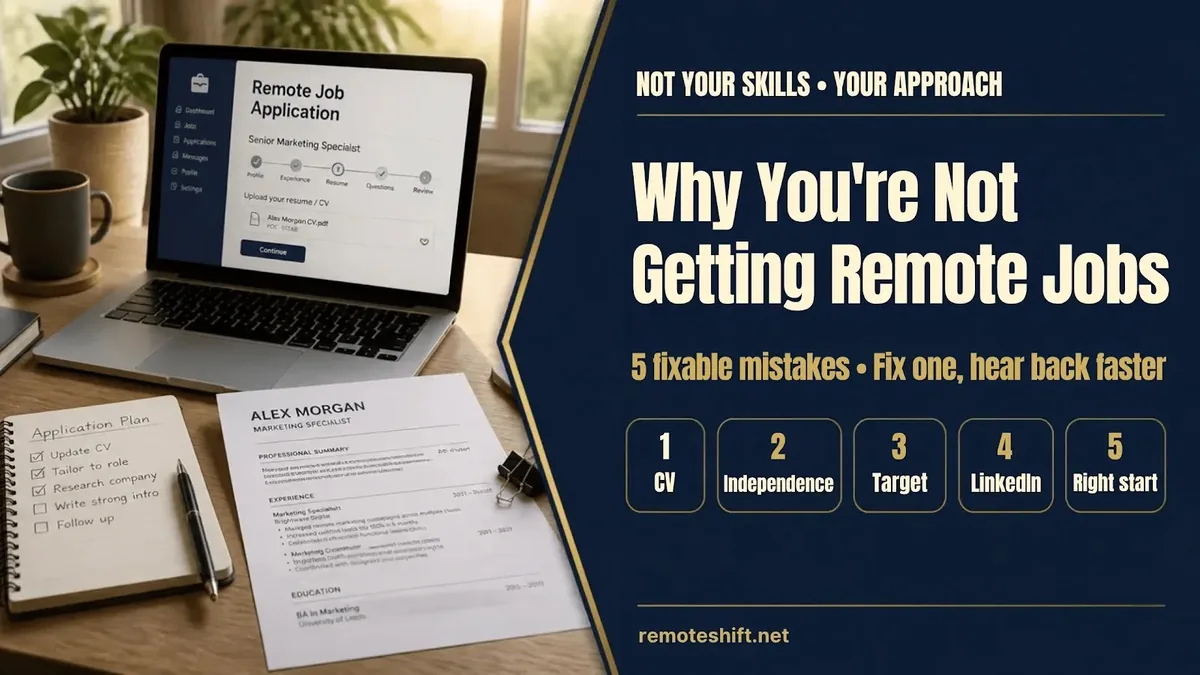
You've applied. Maybe more than once. You spent time on the application, tweaked your CV, hit submit — and then nothing. Or worse, a rejection without even knowing what went wrong.
Now there's a quiet voice in the back of your head saying maybe remote work just isn't for you. Maybe you're not qualified enough. Maybe the competition is too strong.
That voice is wrong. In most cases, the reason people don't land remote jobs has nothing to do with their skills or their experience. It has everything to do with a few specific, completely fixable mistakes. Here's what they actually are.
Mistake 1: Applying for remote jobs the same way you applied for your local job
This is the biggest one — and almost everyone does it.
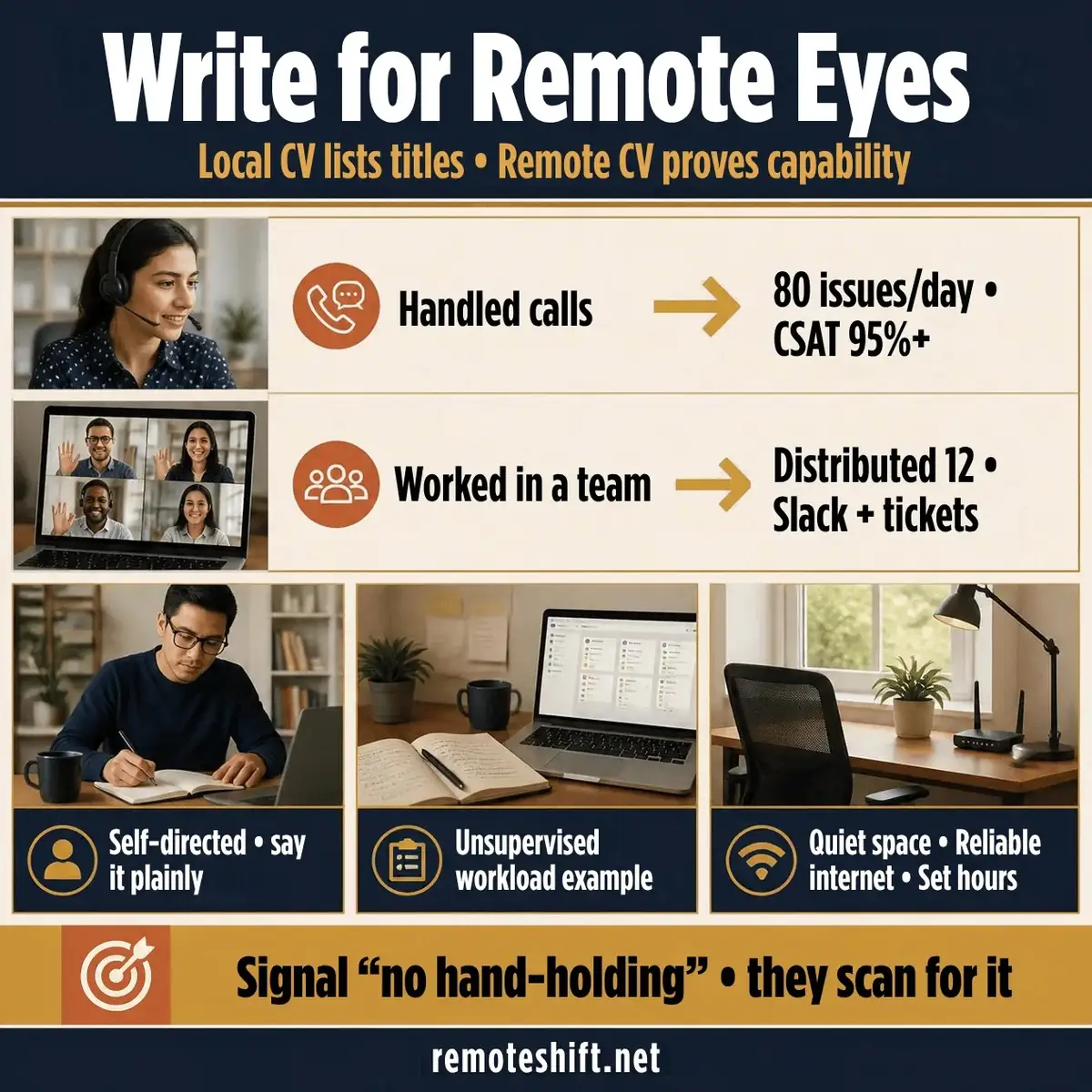
When you apply for a local job, your CV lists where you worked, what your title was, and how long you stayed. That's enough because the employer can call your old boss, they understand the local job market, and they can meet you face to face to fill in the gaps.
Remote employers can't do any of that. They're reading hundreds of applications from people all over the world, and they need your CV to tell the whole story on its own.
That means instead of "handled customer calls," you write: "Resolved an average of 80 customer issues daily across phone and email, maintaining a satisfaction rating above 95%." Instead of "worked in a team," you write: "Collaborated with a distributed team of 12 agents across two time zones using Slack and internal ticketing systems." (These are format examples — use your own real numbers.)
See the difference? One tells them what you did. The other tells them what you're capable of — and signals that you already understand how remote teams work.
Mistake 2: Your application says nothing about working independently
This is what remote employers are most nervous about. Not your skills. Your ability to work without someone watching you.
Every remote application you send needs to address this fear directly. Mention that you're self-directed. Talk about a time you managed your own workload without supervision. Tell them about your home setup — quiet space, reliable internet, dedicated work hours.
These details seem small. They're not. They're the difference between an application that gets read and one that gets skipped. A hiring manager in Chicago or London reading 200 applications from around the world is specifically scanning for anyone who signals "I know how to work without hand-holding." Give them that signal clearly.
Mistake 3: Applying to too many jobs instead of the right ones
There's a version of job searching that feels productive but isn't. You apply to twenty jobs in an afternoon, copy-paste the same cover letter, and tell yourself you're putting in the effort.
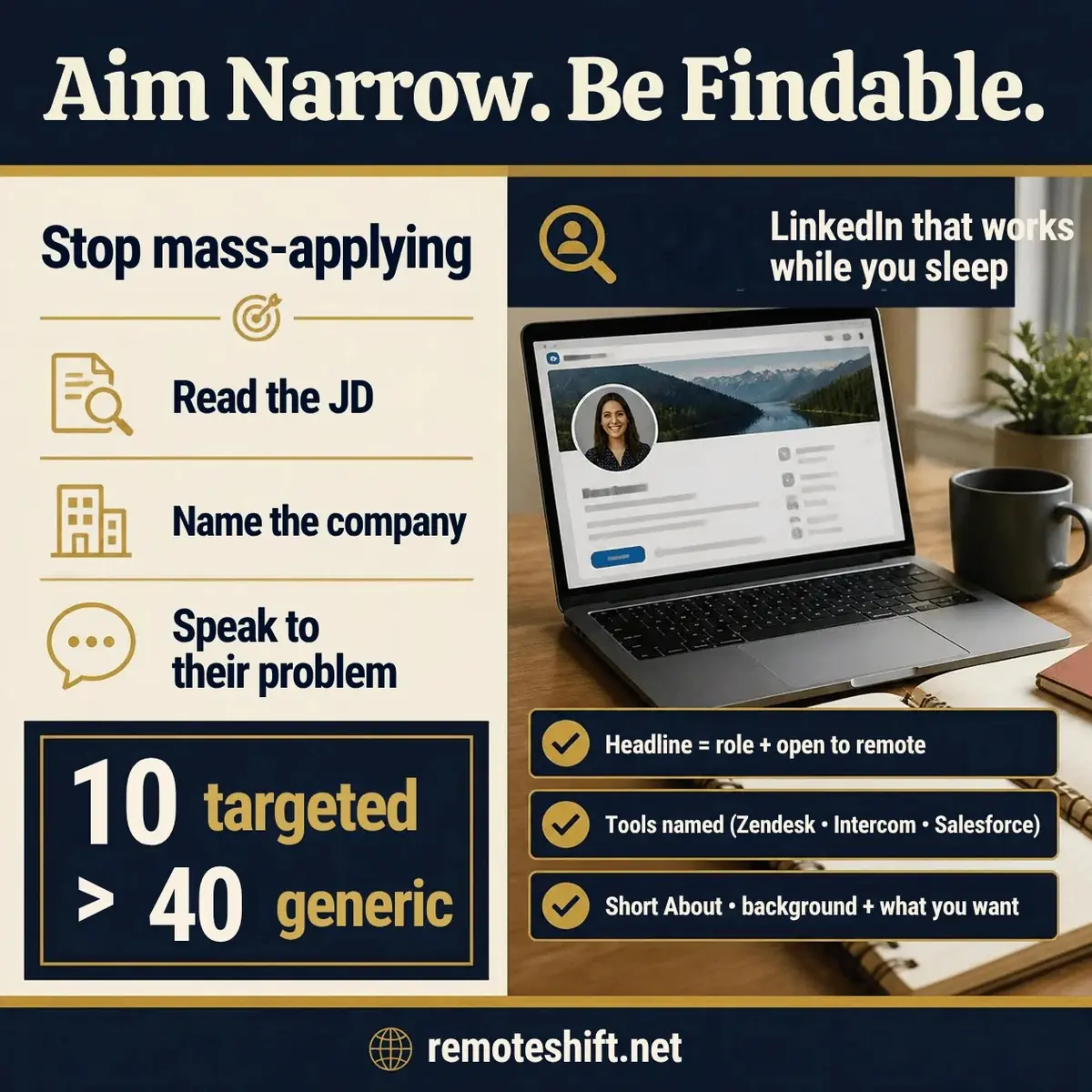
Remote hiring managers can spot a mass application. They've seen thousands of them. What actually works is applying to ten jobs with applications that feel specific — where you've clearly read the job description, you understand what the company does, and your application speaks directly to their actual problem.
Ten targeted applications will consistently outperform forty generic ones. The discipline here is resisting the temptation to "keep the numbers up" and instead slowing down to do each one properly.
Mistake 4: You have no visible online presence
Here's something most people don't consider: the remote job market isn't just about applying. It's about being findable.
A LinkedIn profile that clearly says "experienced customer service professional open to remote opportunities" with specific skills listed does quiet work for you while you sleep. Recruiters search for candidates. If your profile is invisible or generic, you're not in the running even when there's a perfect role.
This doesn't have to be complicated:
- Update your headline to clearly state what you do and that you're open to remote work
- List your actual skills with specific tools (Zendesk, Intercom, Salesforce, etc.) not just vague categories
- Add a short paragraph about your background and what you're looking for
That alone puts you ahead of most people applying for the same roles, because most people don't bother.
Mistake 5: Going after roles that aren't the right starting point
Not all remote jobs are equally accessible to someone starting out. Senior roles, management positions, highly specialized technical jobs — those come later. Right now the goal is your first remote role: get in, build your reputation, collect references, and use that as a springboard.
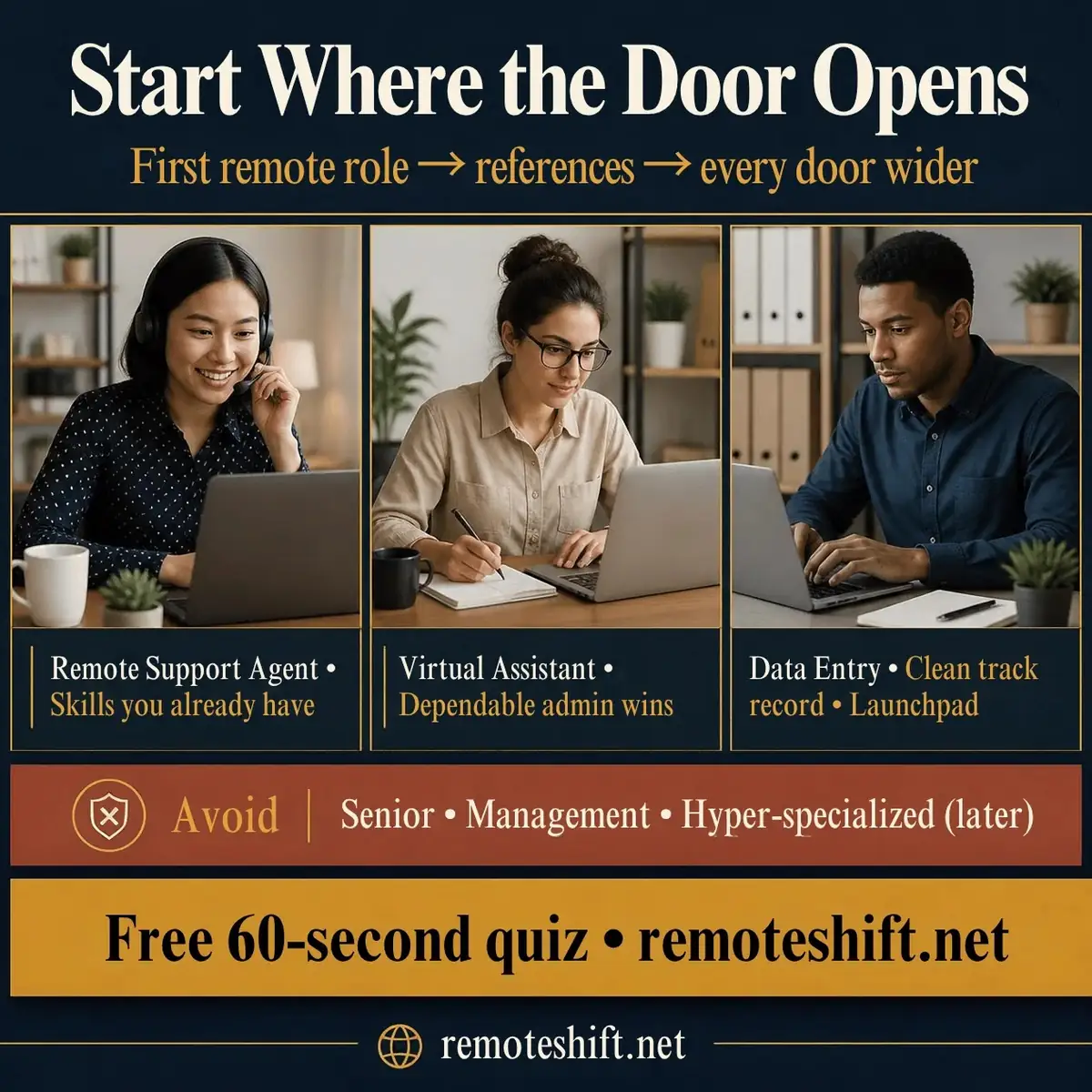
The best starting points for someone with a customer service or admin background are remote support agent roles, virtual assistant positions, and data entry work. These are the roles where your existing skills are enough to get you in the door — and from there, every door opens wider.
If you're not sure which starting point fits your specific background, this is exactly the question our free 60-second quiz was built to answer. It takes your real background and points you to the right remote starting role for you — not eventually, not after three courses, but right now with what you already have. Take it at remoteshift.net.
One more thing
Once you know which role to go after, the next practical step is finding where legitimate remote jobs actually live. Most people look in the wrong places — big job boards that are flooded with competition and scam listings mixed in. For a guide on where the real remote jobs are posted and how to tell a real listing from a fake one, see our article on where legit remote jobs are posted. If you're applying from outside the US, also read how to get a remote job from outside the US.
And once you do land that first role, make sure you can actually receive the pay. Most international remote contractors use Wise — real USD account details, mid-market exchange rate, no minimum balance, and deposits in your local currency within 1–2 business days.
Disclosure: some links in this post are affiliate links. If you sign up through them, RemoteShift may earn a commission at no extra cost to you.
Frequently asked questions
Why is it so hard to get a remote job?
The remote job market is genuinely competitive — a remote listing reaches candidates globally, not just locally. But the bigger issue for most people is that they're applying the same way they'd apply for an in-person job. Remote employers look for different signals, and once you know what those are, getting interviews becomes significantly easier.
How do I make my CV stand out for remote jobs?
Quantify your experience with specific numbers and outcomes. Add references to tools and platforms used for remote collaboration. Explicitly mention your home setup, self-management, and experience working without in-person supervision. These signals matter enormously to remote hiring managers.
Should I tailor my application for each remote job?
Yes — this is non-negotiable for remote jobs specifically. A generic application is immediately recognizable and almost always skipped. Even a small amount of personalization (referencing the company by name, noting something specific about the role) dramatically improves response rates.
What remote jobs are easiest to get with no remote experience?
Remote customer service, data entry, and virtual assistant roles are the most accessible for people with general office or customer-facing backgrounds. These have high hiring volume and don't require prior remote-specific experience.
How long does it take to land a remote job?
It varies significantly by role, background, and how targeted your applications are. People applying for well-matched roles with strong, specific applications typically see first interviews within 2–6 weeks. People mass-applying with generic CVs can go months with nothing. The quality of applications matters far more than the quantity.